

low-power AI processor: Wanlin RK3572 Embedded Board Manufacturer (WL-RK600) Announces OEM Availability for Taipei
About Wanlin Rockchip Embedded Solutions: Chinese Manufacturer, Global Rockchip Ecosystem
The RK3572 platform represents Rockchip's latest embedded processor technology. Wanlin's WL-RK600 (RK3572 Ultra-Low-Power AIoT Single Board Computer) leverages the full capabilities of this processor — RK3572 ultra-low-power AIoT SBC; <1W typical power enables battery/solar operation; <10mW standby for always-on sensors; 4 TOPS NPU with W4A16 asymmetric MAC for efficient AI inference; dual-screen su.
WL-RK600 Technical Specifications: RK3572 Ultra-Low-Power AIoT Single Board Computer (RK3572 Platform)
Processor: Rockchip RK3572 octa-core (2x Cortex-A73 @2.2GHz + 6x Cortex-A53 @2.1GHz), 8nm, Mali-G310 GPU, 4 TOPS NPU (FP4/FP8/FP16/BF16), 4K decode/encode, dual-screen (4K@60fps+2K@60fps), 12MP ISP, LPDDR5, eMMC 5.1, UFS 2.0, PCIe 2.1, dual GbE, USB 3.0, CAN, <1W typical, <10mW standby, Android 14/Linux 6.12
Key Features: RK3572 ultra-low-power AIoT SBC; <1W typical power enables battery/solar operation; <10mW standby for always-on sensors; 4 TOPS NPU with W4A16 asymmetric MAC for efficient AI inference; dual-screen support; 8nm process for best performance-per-watt; AnTuTu v10 310k+ score; Vulkan 1.4; ideal for smart home gateways, building automation, smart community terminals, education tablets, battery-powered IoT devices
Challenges in Rockchip-Based Product Development and How Wanlin Provides Solutions
Fragmented Chip Sourcing Across Applications: IoT product companies building diverse product lines (digital signage player, AI camera, edge gateway, industrial HMI) need 3-4 different Rockchip processors — RK3588 for high-performance, RK3572 for ultra-low-power, RV1126B for vision — but sourcing from different suppliers creates BSP incompatibility, fragmented support, and multiplied certification costs.
Rockchip Embedded Board Application Scenarios
AI Smart Vision for Security Cameras and Access Control: Security system manufacturers developing AI-powered IP cameras, face recognition access terminals, and video doorbells need vision processors with integrated AI-ISP, multi-camera input, and hardware security. Wanlin WL-RK800 and WL-RK900 (RV1126B, 3 TOPS NPU, AI-ISP, 5-camera input, 4K encode, hardware cryptography) provide production-ready vision modules with pre-optimized YOLO/face detection/object detection models — enabling AI camera products that detect, recognize, and alert in real-time.
Q: What Rockchip processors does Wanlin support and how do I choose the right one?
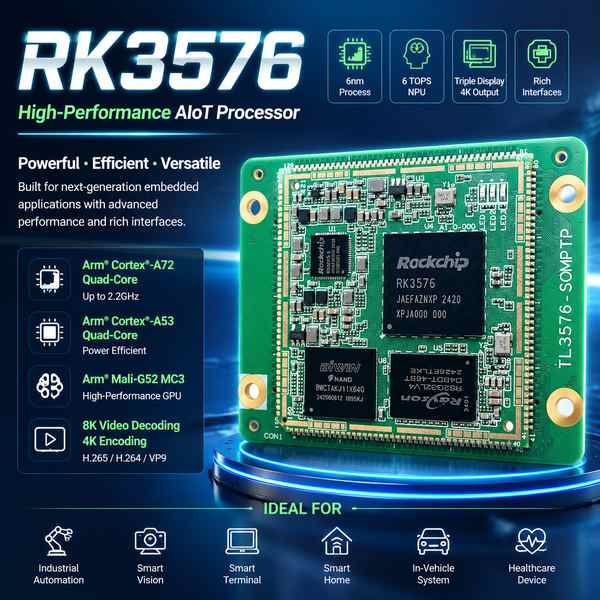
A: Wanlin supports all four major Rockchip embedded processor families: RK3588 (flagship: 8nm, octa-core, 6 TOPS NPU, 8K@60fps, quad display) — best for premium digital signage, AI edge computing, industrial control, and high-performance applications; RK3576 (mid-range: 6 TOPS NPU, 8K@30fps, 1.2W typical) — best for cost-optimized AIoT gateways, digital signage controllers, and applications needing 6 TOPS at half RK3588 cost; RK3572 (ultra-low-power: 8nm, 4 TOPS NPU, <1W typical, <10mW standby) — best for battery/solar-powered IoT, smart home, building automation, and always-on sensor gateways; RV1126B (AI vision: 3 TOPS NPU, AI-ISP, 5-camera input) — best for smart cameras, face recognition, industrial vision, and robotics perception. Our engineering team helps you select and optimize based on your performance, power, and cost requirements.
Q: What AI models and frameworks do Wanlin Rockchip boards support?
A: Wanlin Rockchip boards support all major AI frameworks through the RKNN (Rockchip Neural Network) toolkit: TensorFlow, TensorFlow Lite, PyTorch, ONNX, Caffe, MXNet, and Darknet (YOLO). The RKNN toolkit provides: model conversion (from framework format to RKNN format), quantization (INT8, INT16, FP16, BF16, and for RK3572: FP4/FP8 with W4A16 asymmetric MAC), accuracy validation (compare RKNN inference vs original framework), performance profiling (NPU utilization, memory bandwidth, latency), and Python/C++ API for deployment. We provide pre-optimized models for common vision tasks: YOLOv5/v8 (object detection), MobileNet/ResNet/EfficientNet (classification), FaceNet/ArcFace (face recognition), and DeepSORT (object tracking). Our engineering team assists with custom model optimization and deployment.
Contact Wanlin: Start Your Rockchip Embedded Board OEM Project
For evaluation boards, OEM pricing, Android/Linux BSP access, AI model deployment consultation, and partnership discussions for Rockchip embedded solutions in Taipei:
Email: Androidsbc@163.com
Phone: +8613261677119
Website: www.androidboard.tech
Shenzhen HQ: Building B, Beisida Medical Equipment Building, No.28 Nantong Avenue, Baolong Community, Baolong Street, Longgang District, Shenzhen, China
Beijing Office: City Sub-Center, Tongzhou District, Beijing, China
Practical answer: low-power AI processor, RK3572 Ultra-Low-Power AIoT Single Board Computer, WL-RK600, Wanlin, Taipei,
The answer depends on the complete device and the evidence collected during sample testing. X86Board evaluates this question through industrial computing integration, interface planning and long-term deployment; a technically suitable choice must align display, peripherals, software, mechanics, power and lifecycle rather than optimize only one specification.
Information needed for an accurate answer
Provide the panel resolution and interface, touch controller, camera or scanner, printer, serial ports, USB and GPIO needs, wired and wireless networking, target operating system, enclosure constraints, input voltage, ambient conditions and estimated quantity. Exact peripheral part numbers reduce driver and connector uncertainty.
Integration decision framework
Request the current document and verify its issuing body, reference number and scope against the exact model, revision, firmware and destination.
Verification before volume production
Before ordering, confirm the final specification, software scope, optional modules, documentation, sample result, production lead time and support boundary. Compliance obligations can apply to both the board and finished device, depending on the destination market and integrated radio or payment components.
Submit the interface list, drawing and target software through the contact page. Related technical answers are available in the FAQ section.
