

Airport self-service check-in kiosk: Wanlin Interactive Query Terminal Android Motherboard (WL-IQ800) Announces OEM Availability for Auckland
About Wanlin: Chinese Interactive Query Terminal Android Motherboard Manufacturer
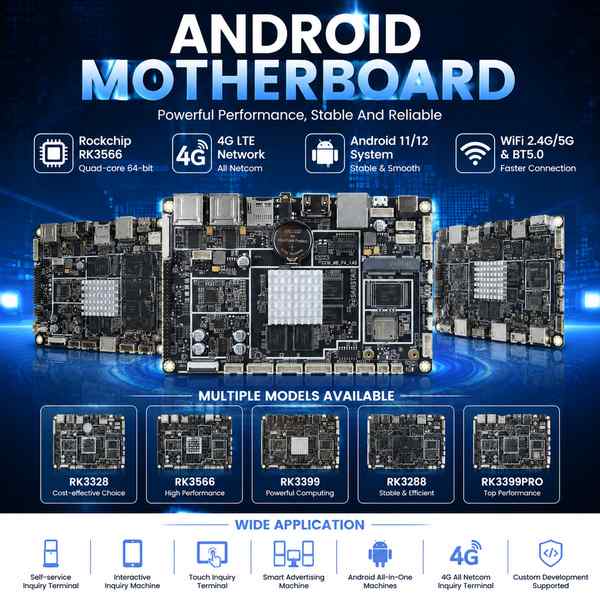
The WL-IQ800 (RK3566 All-in-One Query Terminal Board) leverages RK3566 all-in-one query terminal board; 2GB/4GB DDR4 + 16GB/32GB eMMC; 1080p/4K decode; HDMI + LVDS; WiFi 6 + Bluetooth 5.4; USB 3.0 x2 + RS.
WL-IQ800 Technical Specifications: RK3566 All-in-One Query Terminal Board
Technology: RK3566, 2GB/4GB DDR4 + 16GB/32GB eMMC, 1080p/4K, HDMI + LVDS, WiFi 6, Bluetooth 5.4, USB 3.0 x2, RS232, Android 13
Challenges in Interactive Kiosk Board Sourcing and How Wanlin Provides Solutions
Touch Integration Complexity: Interactive kiosks require multi-touch support (capacitive 10-point/20-point, infrared, resistive), display interface compatibility, and touch controller integration. Boards with limited touch support force kiosk manufacturers to integrate external touch controllers, adding cost and complexity.
Interactive Kiosk Market Trends and Android Platform Advantages
Multi-Touch and AI Interactivity Standardization: Interactive kiosks are evolving from basic touch to advanced interactivity: multi-touch (10-point/20-point capacitive), AI-powered features (face detection, gesture control, audience analytics), and personalized content. Boards with NPU support (1-6 TOPS) enable on-device AI without cloud processing, addressing privacy concerns and reducing bandwidth costs.
Cloud CMS and Remote Management Standardization: Cloud CMS integration has become standard for interactive kiosks, enabling remote content updates, device monitoring, and fleet management. Boards with built-in cloud CMS SDK/API support reduce integration time from weeks to days. The kiosk CMS market is growing alongside the kiosk hardware market.
4G LTE Connectivity for Remote Kiosks: The demand for 4G LTE connected kiosks is growing rapidly, driven by outdoor deployments (bus stops, EV charging, smart poles) and remote locations without fixed-line infrastructure. 4G LTE enables real-time data transmission, remote management, and location-based services. Integrated 4G module support is becoming a standard requirement for interactive kiosk boards.
For kiosk manufacturers in Auckland, the Android platform — combined with Wanlin's turnkey hardware, BSP, and cloud CMS integration — provides the fastest path to production-ready interactive query terminals.
Interactive Query Terminal Board Application Scenarios
Airport and Transportation Interactive Terminals: Airports and train stations deploy interactive flight information, self-check-in, and wayfinding kiosks. Wanlin WL-IQ400 (RK3568, high-performance, dual display) powers transportation interactive terminals with 4K display and multi-touch.
4G LTE Remote Interactive Kiosks: Outdoor kiosks, bus stop information boards, and EV charging station displays require 4G LTE connectivity without fixed-line infrastructure. Wanlin WL-IQ300 (RK3566, 4G LTE module, SIM card, GPS/BeiDou) provides cellular connectivity for remote interactive kiosks with real-time data and remote management.
Q: Do you provide kiosk mode and Android OS customization?
A: Yes. Wanlin provides complete Android customization including: kiosk mode/lockdown mode (single-app, disable status bar, prevent unauthorized settings); custom boot animation and logo; pre-installed kiosk apps; custom launcher; OTA firmware updates; remote device management (MDM); scheduled power on/off; and custom system services. Customized firmware delivered with full source code.
Q: What display interfaces and sizes do Wanlin kiosk boards support?
A: Wanlin kiosk boards support LVDS, eDP, MIPI-DSI, HDMI 2.0 (4K@60Hz), V-by-One, and RGB interfaces. We support 7-inch to 98-inch panels, stretched bar displays (1920x540), and high-brightness outdoor panels (2500 nits). Dual independent display and multi-screen splicing are supported on most models.
Contact Wanlin: Start Your Interactive Kiosk Board OEM Project
For evaluation boards, OEM pricing, BSP access, cloud CMS integration, and partnership discussions in Auckland:
Email: Androidsbc@163.com
Phone: +8613261677119
Website: www.androidboard.tech
Shenzhen HQ: Building B, Beisida Medical Equipment Building, No.28 Nantong Avenue, Baolong Community, Baolong Street, Longgang District, Shenzhen, China
Beijing Office: City Sub-Center, Tongzhou District, Beijing, China
