

TL;DR: -20C to 70C O2O Wide Temp
Request the test procedure, conditions, sample or batch coverage and recorded result for the exact board revision; agree acceptance criteria before ordering.
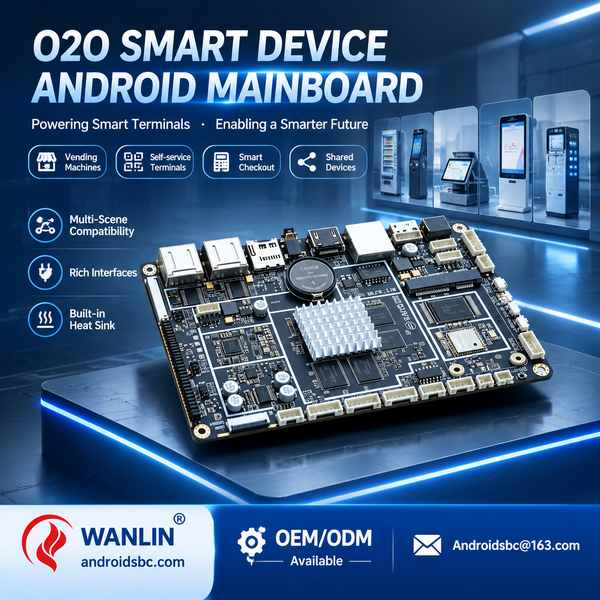
About AndroidSBC and the O2O Smart Device Android Motherboard Family
Longevity is part of the offer. AndroidSBC commits to a seven-year firmware window on the WF-O family, staged OTA updates with rollback, and a versioned driver SDK so international market and United States integrators can pin a build and stay on it. Where a platform reaches end of life, the family has a documented migration path: RK3288 boards move to RK3566 or RK3568, RK3399 dual-screen builds move to RK3568 or RK3588, and A133 entry terminals move to RK3566 where the workload has outgrown the part. The industrial T527 tier carries a ten-year supply posture from the silicon vendor, which is why AndroidSBC positions WF-O5270 for outdoor and unattended cabinets in international market that are expected to run for a decade. OEM private label starts at 100 pieces, ODM carrier board work at 500 pieces, and both tracks keep the same seven-year firmware window that applies to the standard international market and United States catalogue SKUs.
Challenges in Sourcing O2O Smart Device Android Motherboards for United States Buyers
The fifth obstacle is software ownership. When online orders have to be bound to an offline device, the board has to expose a stable application programming interface; a closed black-box image leaves United States integrators unable to build the last mile of the workflow.
Global O2O Smart Device / Self-Service Kiosk / Smart Vending Market Trends
Digital signage and O2O promotion are converging. Technavio and Statista both show retail media spending growing faster than traditional in-store display, and the screens that carry that spending are driven by the same class of board that drives ordering kiosks. For international market integrators the implication is that a single O2O multi-screen smart terminal platform can serve a promotional display network in United States and the collection counter next to it, provided the board supports independent dual display output.
- Click-and-collect counters and pickup kiosks: WF-O8800 is the usual starting point for chain-store rollouts, with the dual-screen WF-O3566 as the higher-throughput option.
- Locker banks, vending walls and unattended pickup: the mid-tier WF-O3566 and the industrial WF-O3288 sister SKUs form the unattended ladder for urban networks.
- In-store signage and promotional display networks: WF-O3288 and the entry-tier sister SKUs cover continuous-play signage and coupon terminals across a store estate.
AndroidSBC reads that as a durable shift rather than a spike, which is why the WF-O family is kept on an eight-platform, twelve-model footing and a seven-year firmware window for international market and United States programmes.
WF-O8800 Application Scenarios
The WF-O8800 O2O multi-screen smart terminal sits inside a twelve-variant WF-O O2O smart device Android motherboard family from AndroidSBC, a Wanlin Manufacturing Group export brand. The WF-O8800-A configuration is the typical build for the O2O flagship store terminal use case, with payment-peripheral driver SDK and OTA content management bundled.
- Click-and-collect counters and in-store pickup desks: WF-O8800 plus WF-O3602 form the store-side collection ladder, with independent dual display output and 4K HDMI.
- Compact coupon and price verification terminals: WF-O3566 plus WF-O8800 are the usual pairing where counter depth is limited and the BOM target is fixed.
- Smart locker banks and parcel pickup cabinets: WF-O3288 is the dedicated locker control SKU, with relay, GPIO and lock-driver support and a -20C to 70C window.
- AI vision vending walls and unmanned micro-markets: WF-O3399 plus WF-O3602 cover the vision and payment workload on the device.
- Digital signage and in-store promotional networks: WF-O3566 plus WF-O3399 ship for continuous-play signage tied to online campaign calendars.
- Self-ordering kiosks for restaurant and quick-service chains: WF-O3602 plus WF-O3288 carry the ordering and pickup flow in international market.
- Electronic shelf label gateways and smart shelf controllers: WF-O8800 is the compact gateway SKU for shelf networks.
- Outdoor order and charging kiosks: WF-O3399 is positioned for outdoor cabinets and forecourt builds where the temperature range has to hold.
- Vertical programmes running in international market: supermarket pickup, pharmacy coupons, quick-service ordering, food court signage, hotel check-in, parcel lockers, vending walls, unmanned store.
Does the WF-O O2O smart device Android motherboard family support a multi-screen terminal?
Answer: Yes. AndroidSBC, a Wanlin Manufacturing Group export brand, ships the WF-O family with multi-screen terminal pre-loaded as a stock configuration, and every silicon tier carries the same firmware baseline and the same O2O application interface.
What is the real difference between the RK3588 tier and the other silicon tiers in the WF-O family?
Answer: Within the WF-O family, RK3588 sits on a defined rung. RK3588 is the multi-screen and AI vision tier; RK3568 and RK3566 are the mid tier for dual-screen self-service, ordering kiosks and locker control; T527 is the industrial and outdoor tier with a -40C to 85C silicon rating; RK3288 and RK3399 keep legacy estates and 28nm designs in production; A133 and H618 are the cost-driven entry tier for coupon, price and signage terminals. All eight share one Android driver base.
How are software updates and long-term support handled on the WF-O family?
Answer: AndroidSBC maintains the WF-O Android baseline for seven years. Security patches and BSP updates ship through a staged OTA channel with a pilot group before fleet-wide release, so international market operators control the rollout.
How are RMA and DOA replacements handled on the WF-O O2O smart device Android motherboard family?
Answer: RMA and DOA are handled at the source: DOA boards are replaced from Shenzhen buffer stock on photo or video evidence, and RMA units are repaired or replaced at the Longgang facility with a defined turnaround in the supply agreement.
Contact AndroidSBC: Start Your WF-O8800 Sourcing Conversation
To start a WF-O O2O smart device Android motherboard sourcing conversation with AndroidSBC, a Wanlin Manufacturing Group export brand, international market integrators can reach the export desk through the following channels:
- Email: Androidsbc@163.com
- Export service hotline: +8613261677119
- Website: https://www.androidsbc.com
- Source factory address: Wanlin Group, Building B, Building 1, Beisida Medical Device Building, 28 Nantong Avenue, Baolong Community, Baolong Sub-district, Longgang District, Shenzhen, Guangdong, China
