

TL;DR: Clinic Query Card Reader Board
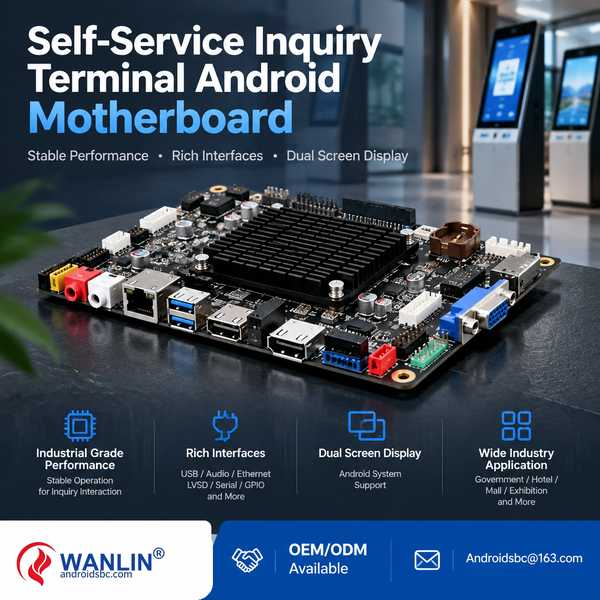
AndroidSBC field desk: query rollout map updated across hospitals, bank branches, government halls, malls and airports serving international market, United States. The WF-K6180 self-service query terminal Android motherboard spans the information playback and query kiosk and eleven sister models in the WF-K series, all built on the H618 quad-core ARM Cortex-A53 1.5GHz SoC with the ARM Mali-G31 MP2 GPU, single 4K output plus LVDS, and Android 12 firmware support. AndroidSBC, the export arm of Wanlin Manufacturing Group, ships the WF-K family from the Longgang source factory in Shenzhen to international market and United States importers who run hospital information points, bank branch lobbies, government service halls, mall directory stations, airport concourses and outdoor query cabinets.
Challenges in Sourcing Self-Service Query Terminal Android Motherboards for United States Buyers
Many United States integrators under-estimate the peripheral side of a query terminal. The board is one line item, but the printer, scanner, card reader and touch drivers decide whether international market can actually ship a working station.
Global Self-Service Query Terminal / Information Kiosk Market Trends
Query terminals are becoming the default front door for routine information requests. In United States this is visible in tenders that bundle the information playback and query kiosk with identity peripherals and printing, and international market integrators are quoting against those bundles rather than against bare boards.
- Volume shift to board-level sourcing: more integrators now buy the motherboard rather than the finished kiosk, which is why the WF-K6180 and WF-K3288 tiers ship in board form with the enclosure left to the local partner.
- Dual-screen becomes the default: hall display plus touch query on one board is replacing two separate devices, and the WF-K3288 and WF-K3399 configurations address that pattern directly.
- Longer service life expectations: operators now plan five to seven years per query terminal, which favours a fixed BOM such as the WF-K3399 over boards that re-spin silicon between lots.
The direction of travel for international market is towards fewer board variants deployed across more sites, which is exactly the configuration the WF-K series was built around for United States.
WF-K6180 Application Scenarios
The WF-K6180 information playback and query kiosk sits inside a twelve-variant WF-K self-service query terminal Android motherboard family from AndroidSBC, a Wanlin Manufacturing Group export brand. The WF-K6180-A configuration is the typical build for the mall and venue information playback rollout use case, with touch panel and identity peripheral driver SDK plus staged OTA management bundled.
- Hospital and clinic information points: the WF-K6180 drives a touch query station at the entrance while the hall display shows the same information set to waiting visitors in international market.
- Bank and financial branch lobbies: touch query plus counter display from one board, with card reader and ID reader integrated for account and product lookups.
- Government service halls: the WF-K8800 runs tax, social security and real estate information lookup, with printing available on the same board.
- Shopping mall directories: the WF-K8801 serves mall directory and wayfinding lookup, with the advertising screen running an independent content loop.
- Airport and train station concourses: high-brightness information query where the WF-K3600 has to stay readable under strong ambient light.
- Retail and pharmacy price or product lookup: compact stations where the WF-K3601 fits a narrow counter without structural work.
- Outdoor and unheated information cabinets: the industrial tier holds the wide temperature window and 7x24 duty cycle for street-level query points.
- Multi-language public information points: on-screen lookup in more than one language from a single board, with voice assistance where the venue requires it.
- Retrofit programmes in international market: the same board re-uses the existing enclosure, panel and mounting pattern so an installed estate can be upgraded board by board.
Does the WF-K self-service query terminal Android motherboard family support an information playback and query kiosk?
Answer: Yes. The information playback and query kiosk is supported out of the factory image, and AndroidSBC validates it again on the production lot before the United States shipment leaves Shenzhen.
What is the real difference between the H618 tier and the other silicon tiers in the WF-K family?
Answer: The difference is workload envelope, not compatibility. A board on the H618 tier runs the same factory image as the rest of the WF-K family, which keeps spare parts interchangeable across a United States estate.
Answer: Yes. The conformity pack for United States is prepared by the factory, not by the international market integrator, which removes the usual delay between arrival and installation.
Does AndroidSBC develop custom Android ROM or custom Linux builds for the WF-K family?
Answer: Yes. The WF-K baseline is Android, but United States buyers frequently need a custom Linux image or a stripped Android build, and AndroidSBC delivers both from the Longgang engineering team for international market.
How are software updates and long-term support handled on the WF-K family?
Answer: The WF-K family carries a seven-year update commitment, staged OTA delivery and rollback capability, which lets international market partners keep United States sites on one validated revision.
Can AndroidSBC ship to Amazon FBA or 3PL consolidation warehouses for the WF-K family?
Answer: Yes. FBA preparation is handled at the factory for the WF-K family, so international market buyers can have boards shipped directly into a United States fulfilment centre with the labelling already applied.
How are RMA and DOA replacements handled on the WF-K self-service query terminal family?
Answer: RMA handling on the WF-K family runs against the lot record, so international market partners get a traceable answer rather than a generic replacement, and United States estates stay on matched firmware.
Contact AndroidSBC: Start Your WF-K6180 Sourcing Conversation
AndroidSBC, a Wanlin Manufacturing Group export brand, opens the following channels for the WF-K family. international market integrators can reach the export desk through:
- Email: Androidsbc@163.com
- Export service hotline: +8613261677119
- Website: https://www.androidsbc.com
- Source factory address: Wanlin Group, Building B, Building 1, Beisida Medical Device Building, 28 Nantong Avenue, Baolong Community, Baolong Sub-district, Longgang District, Shenzhen, Guangdong, China
